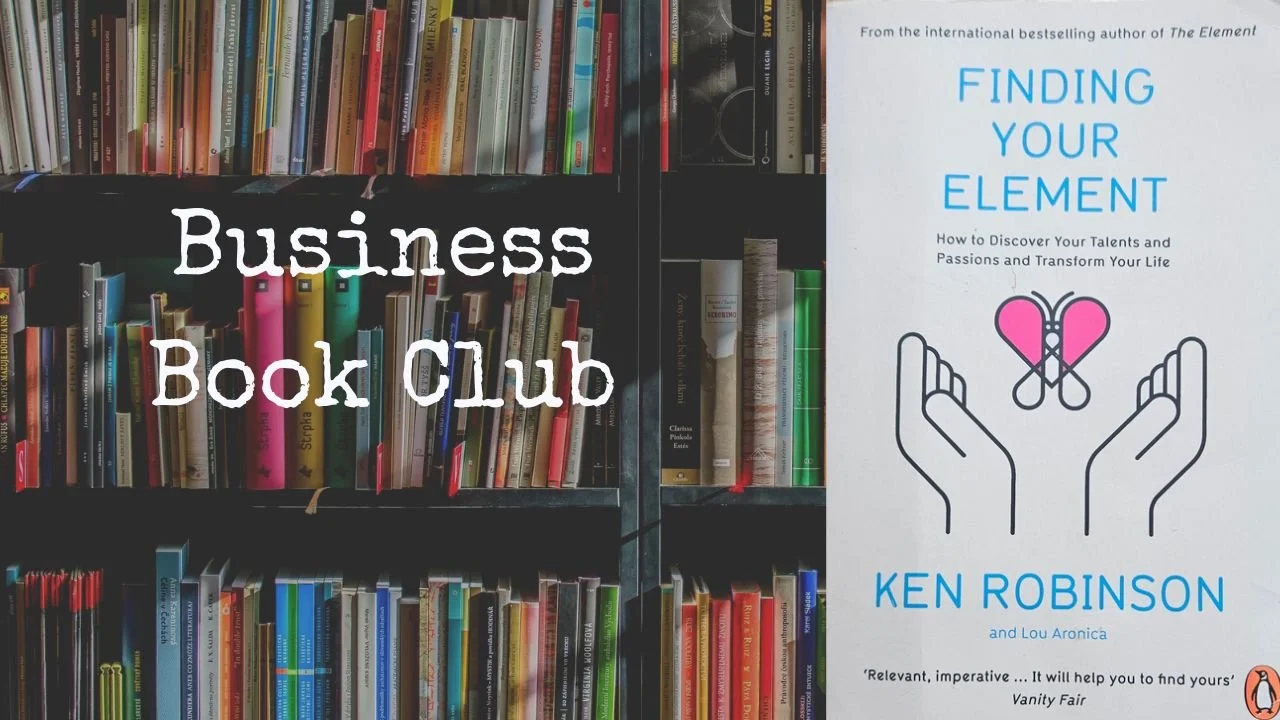
Business Book Club: Finding Your Element by Ken Robinson
I’ve just finished reading Finding Your Element by Ken Robinson and, you might not be surprised to hear it struck a chord with me.
The Book
The premise of the book is fairly simple: your “element” sits where your natural strengths and the things that energise you overlap.
Not just what you’re good at.
Not just what you enjoy.
Both.
That sounds straightforward enough, but the more I reflected on it, the more I realised how many people build careers almost entirely around competence. They become the reliable one, the safe pair of hands.The person who can always sort the problem. Which is brilliant… until one day they realise they’re highly capable in an area that doesn’t actually light them up very much anymore.
I see this a lot in leadership and career conversations. People often assume dissatisfaction means they need a dramatic career change, when sometimes the issue is simply that too much of their week sits outside their “element”.
What I Learned
The book explores something I found particularly interesting: how many of our assumptions about ourselves are old stories we’ve stopped questioning.
“I’m not creative.”/“I’m not confident.”/“I’m not that kind of person.” According to Robinson, many of these beliefs are inherited from school, work, family expectations or past experiences rather than actual truth. A lot of adults are walking around with identities formed decades ago.
One of the themes I enjoyed most was Robinson’s focus on exploration rather than certainty. He doesn’t position finding your element as a neat, linear process. It’s much more organic than that. Trying things. Following curiosity. Meeting different people. Paying attention to energy. That feels especially relevant now, when careers rarely follow tidy ladders anymore. Most people’s working lives are a mixture of skills, interests, opportunities, accidents and experiments.
I also liked Robinson’s idea of finding your “tribe”: the people who share and encourage your interests. There’s something powerful about being around people who make a part of you feel more normal, more possible or more developed. Sometimes capability grows simply because the environment changes.
One thing that didn’t fully land for me though was some of the language around aptitude. To be fair, the book was written at a time when strengths-based development wasn’t nearly as mainstream as it is now. Since then, there’s been a huge shift in how we think about strengths, energy, personality, motivation and human potential at work.
At times, the book felt a little fixed in its view of talent, whereas I tend to believe people are often more adaptable and expandable than they realise. Environment, confidence, identity and opportunity all shape capability too.
This book is also a follow-up to The Element and is positioned much more as the “how to” companion. There are reflective exercises throughout and they’re perfectly useful. But I did wonder whether some readers might still walk away feeling frustrated that they haven’t quite “found” their element yet. I think that’s partly because the idea itself can feel slightly elusive. Almost like there’s one hidden thing deep inside you waiting to be discovered. I’m not entirely convinced it works like that.
Sometimes clarity comes from action rather than introspection.
From doing things.
Trying things.
Noticing patterns over time.
What Did I think?
In some ways, this was another example of me reading a book that largely reflected back things I already know, believe and work with every day. So I wasn’t quite as “wowed” by it as I’d hoped to be. But I also had to keep reminding myself when this was written.
For its time, Robinson was well ahead of where many workplaces, schools and leaders were thinking. Long before conversations about strengths, squiggly careers, fulfilment and purpose became common, he was challenging narrow definitions of intelligence and success. And even today, a lot of organisations are still catching up with this.
That said, I do think there’s a slight risk with books like this that readers can come away thinking they need to discover one perfect calling hidden deep inside themselves. I’m not convinced that exists for everyone. Sometimes fulfilment comes less from finding the thing and more from creating a life with enough of the right things in it: interesting work, good people, autonomy, challenge, meaning, variety, space to grow.
Still, I found the book thoughtful, encouraging and very human. And perhaps the biggest takeaway for me: just because you’ve become known for something doesn’t mean you have to stay there forever.
Especially if there’s another part of you waiting to be used.